
Free Guide:
7 Things You Need to Build a Strong Food Safety Culture

Whether a company is destined for success or doomed to failure depends largely on its culture.
This is especially true in the food industry. A strong food safety culture can be the difference between a company that scales up and becomes a beloved national brand and one beset by compliance failures, high turnover, and food safety incidents.
Food safety culture is a set of shared values, beliefs, and norms that help build a mindset and operating system in which safety is like second nature to employees. Or, to put it differently, a strong food safety culture means employees do what they’re supposed to do for safety, even when no one is watching.
According to the Global Food Safety Initiative, there are five dimensions to food safety culture:





- Vision and Mission:
- Leadership defines the mission and expectations for safety culture hazards
- People:
- Employees are empowered to uphold food safety
- Consistency:
- Objectives and tasks are clearly defined and align with training
- Adaptability:
- Teams can adjust to changes in guidelines, rules, and conditions.
Hazards and Risk Awareness:
Employees at all levels know how to spot hazards
Building a strong food safety culture also requires taking a closer look at your company's makeup and ensuring you have the right components in place. In this free Rootwurks guide, we’ll walk you through 7 key requirements for a strong food safety culture, and provide you with a handy self-assessment guide at the end to see how you stack up.
7 Key Components of a Strong Food Safety Culture
Leadership Buy-in:
Leadership must provide the staffing, time, and budget for safety training. They must delegate stop work authority to managers and frontline workers to prevent a safety incident, ensuring that safety concerns - not the bottom line - remain the ultimate deciding factor.


Employee Empowerment:
Employees must be encouraged to speak up about safety concerns and take action without fear of reprimand from management or ostracism from coworkers. Every worker must be empowered to protect the brand, with the support of management and peers.
Clarity and Alignment:
Communication must be multilingual, visual, and verified through on-the-floor performance. Employees must be empowered to tell management when, where, and how safety or production expectations don’t fit the realities of the workfloor.


The Right Tools:
Companies must invest in tools to maximize safety and foster a strong safety culture. This includes ergonomic PPE, equipment designed for hygiene, and regular, predictive maintenance. For training, the workplace must deploy dynamic, up-to-date point-of-work visual guides.
Accountability and Recognition:
Accountability must be top-down, with both supervisors and frontline workers held accountable for safety. Companies should not only recognize safety shortcomings but also highlight those workers who are going above and beyond.


Training is Customizable, Impactful, and Reinforced:
To boost safety training retention, companies must ditch generic training and deploy site-specific micro learning that integrates with the workflow. Learning content must be customized to reflect the unique challenges employees face.
Verification and Recordkeeping:
Recordkeeping is a key component of a holistic food safety culture that takes a preventive and proactive approach to risk. It helps companies get strategic about food safety and pinpoint where more improvement is needed.
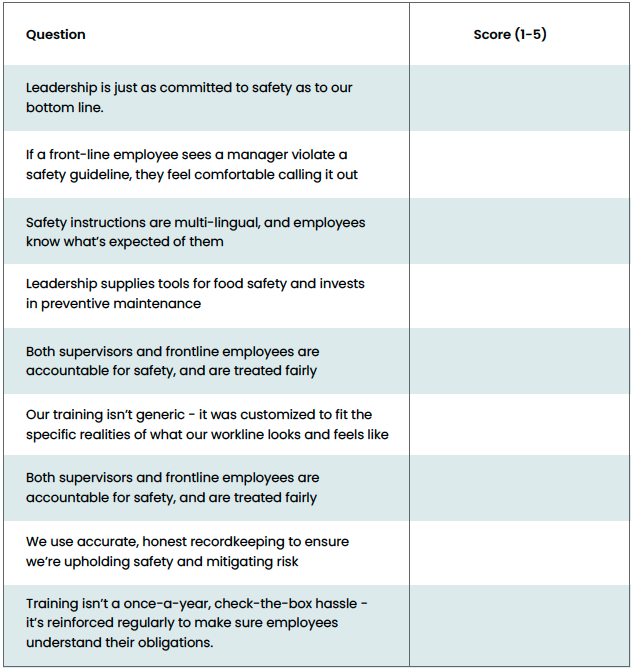
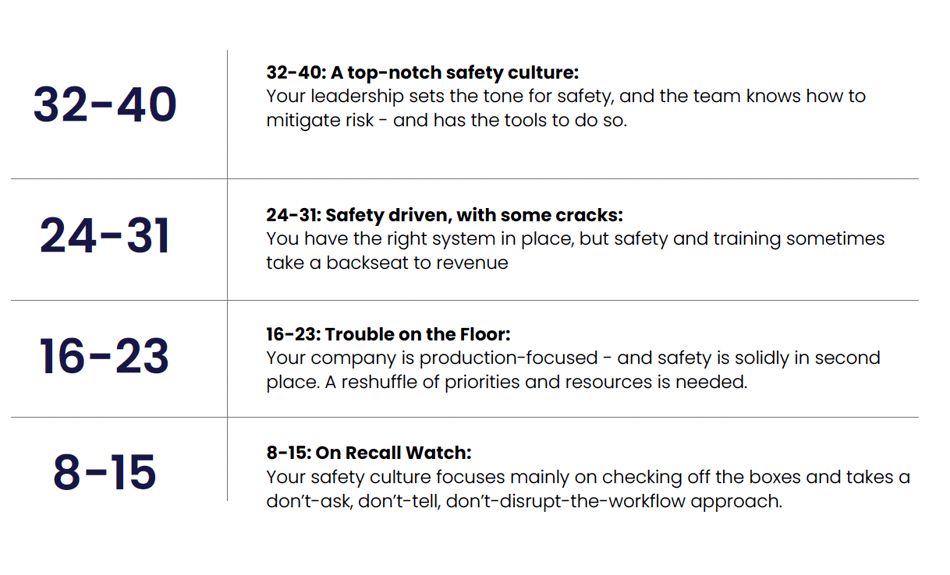
The Culture Check: How Does Your Company Rate?
Rate each statement from 1 (strongly disagree) to 5 (strongly agree). And this test is purely confidential - an honest assessment is best!
Food Safety Culture: No Longer Just a Theory
Food companies across the world have gotten the memo in recent years: food safety culture is no longer just a concept; it’s a real, tangible, measurable approach to daily operations. And with the release of SQF Edition 10, food safety culture is at the center stage more than ever before.
Under the latest version of this globally recognized food safety certification program, one update stands out: the requirement for a robust, well-documented food safety culture assessment plan.
The assessment plan must include:

Two-way communication strategies

Measurable objectives and performance reviews

Training programs for employees and management

Tools to collect and address feedback from all personnel

The goal of this guideline - and for any robust training program - is to make food safety culture an organizational mindset and not just a checklist to knock out once a year.
That’s also part of the foundation of our mission at Rootwurks - to help companies build a culture that prioritizes safety and learning, allowing them to scale up safely, maintain quality and efficiency, and empower their employees to be the stewards of their culture.
It’s also central to Rootwurks Consulting, which we launched this past year to provide companies with access to leading industry experts for on-site training, strategic consulting, and customized documentation to master food safety.
To learn more about how we help companies build a stronger food safety culture - no matter how hectic their workflow - reach out to a member of our team here
Your Culture is Everything: See How Rootwurks Helps
To get a personalized demo of how the Rootwurks platform and our tools, features, and customizable learning plans help companies build a culture that prioritizes safety and learning, reach out to a member of our team today.