
Building a Strong Food Safety Culture:
Your Roadmap to SQF Edition 10
Recognized worldwide as one of the top food safety certification programs, SQF includes a series of rigorous guidelines that help companies mitigate risk, enhance safety culture, and attain a certificate that helps burnish their reputation for safety. Officially released on March 2nd 2026, the latest edition of SQF is no different.
What's new in SQF 10?
According to the SQF Institute, the updates in edition 10 are designed to “strengthen the connection between certification and real-world food safety performance.”
Edition 10 includes scoring and methodology changes that the SQF Institute states are intended to make it more risk-focused and improvement-oriented.
Instead of focusing solely on a numerical score, SQF 10 auditing will examine the type and severity of non-conformances and focus on clauses that are fundamental to food safety (such as management commitment, sanitation, and allergen management). Auditors will emphasize the most critical risk areas, providing a clearer assessment of a site’s food safety culture, the SQF Institute states.
The scoring and methodology changes in Edition 10
include new guidelines for:
Change management
Corrective and Preventive Actions (CAPA)
Root Cause Analysis
Environmental Monitoring Programs
Documentation and Recordkeeping
Training and Competency
Scoring Audit compliance
Cybersecurity in food defense
Recall and Crisis Management Protocols
Expanded technical updates
But one update stands out: the requirement for a robust and
well-documented food safety culture assessment plan.
What is Food Safety Culture?
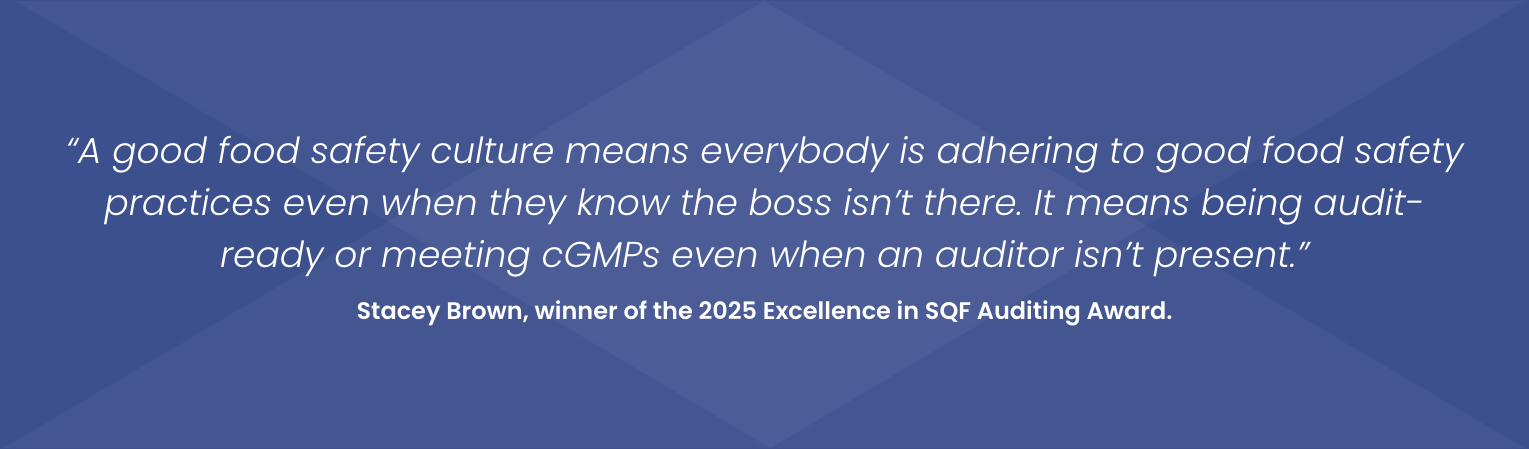
The Global Food Safety Initiative (GFSI) defines food safety culture as “shared values, beliefs and norms that affect mindset and behaviour toward food safety in, across, and throughout an organization.”
Building a food safety culture requires the commitment of an entire organization and must be integrated into operations from the top down. And the consequences of not developing a strong food safety culture are hard to overstate.
In 2011, the Grocery Manufacturers Association and the Food Marketing Institute estimated that the average cost of a food recall in the United States is $10 million - and that figure only includes the costs of retrieval and disposal of the recalled products. Once fines and lawsuits are factored in, the eventual costs can soar much higher - and the damage to a company’s reputation can take years to repair.

The GFSI's Five Dimensions of Food Safety Culture


Vision and Mission:
Leadership defines the company's mission and sets expectations for food safety and culture.
People:
Employees are given responsibilities and empowered to uphold food safety



Consistency:
Safety tasks align with employee training, with clear protocols for documentation and accountability. Objectives are defined
Adaptability:
Facilities and companies must adjust to changes in guidelines, rules, and conditions.
Hazards and Risk Awareness:
Maintain the ability to recognize actual and potential hazards and risks at all levels
What Does SQF Require for Food Safety Culture?
What must the food safety culture assessment plan include?
Two way
communication
strategies
Measurable
objectives and
performance reviews
Training
programs for
employees and
management
Tools to collect
and address
feedback from
all personnel
Under SQF Edition 10, companies must create a clear, documented food safety
culture assessment plan that includes procedures for culture assessment and
improvement. The goal is for companies to view food safety culture as an
organizational mindset instead of simply a checklist to go through.
Organizations seeking certification for SQF 10 must also demonstrate
comprehensive strategies for:


Effective communication:
Employees are informed and engaged with food safety activities
Comprehensive employee training:
Employees and management are trained for the demands of the food safety culture
Systematic feedback mechanism:
Employees are empowered to speak up on food safety and expect feedback
Continuous improvement processes:
Includes regular measurement and evaluation of food safety activities
How to Build a Food Safety Culture
Building a robust food safety plan is not a “one size fits all” proposition. It requires careful consideration of the unique hazards a company or facility faces in its daily operations.
What You Need to Build a Food Safety Culture

Leadership Buy-in:
Improving culture requires a full commitment - from top to bottom.

Employee Education:
Employees must be trained on key food safety principles and understand their role in the culture.

Recordkeeping:
Employee performance on safety and training must be carefully recorded to boost efficiency and retention.

Accountability:
Training and safety tasks must be backed by consistent accountability for employees and leadership

Praise for employees:
Leadership should make positive recognition for employee proficiency a key part of the workplace culture.

Open communication:
Employees should be empowered to speak up about safety and training issues that concern them - and not fear the consequences of doing so.

Reinforcement of training:
Leadership should schedule repeated reinforcement of training to check retention and foster continuous improvement.
Building a Food Safety Plan

To build a food safety plan rooted in HACCP (Hazard Analysis and Critical Control Point) principles - a requirement of SQF 10 - a company must first meet the 5 preliminary steps and 7 principles of HACCP.
The 5 Preliminary Steps of HACCP:
- Assemble the HACCP Team
- Describe the Food and its Distribution
- Describe the Intended Use and Consumers of the Food
- Develop a Flow Diagram Which Describes the Process
- Verify the Flow Diagram

The 7 HACCP Principles:
The Food and Drug Administration describes HACCP as “a systematic approach to the identification, evaluation, and control of food safety hazards,” based on the following seven principles:
- Conduct a hazard analysis
- Determine the critical control points (CCPs)
- Establish critical limits
- Establish monitoring procedures
- Establish corrective actions
- Establish verification procedures
In addition, the company must develop a strong foundation of prerequisite programs designed to support the food safety plan. This includes developing and implementing robust SOPs (Standard Operating Procedures) that guide employees through Good Manufacturing Practices (GMPs) for crucial risk mitigation measures, such as sanitation and allergen management. The company must develop and implement corrective actions for any and all safety shortcomings.
In addition, comprehensive training is essential to guide employees through these processes and must include benchmarks for assessing employee proficiency and finding areas for improvement or reinforcement.

Employees Keep Falling Off the 90-Day Cliff
With food safety culture so central to SQF Edition 10, Rootwurks is uniquely positioned to help companies build a holistic approach to food safety and meet these new certification guidelines.

Employee Empowerment:
Rootwurks empowers frontline staff to take ownership of food safety, giving them a voice and guided training to make food safety central to company culture.

Effective Communication:
The Rootwurks platform helps ensure clear and consistent communication and food safety messaging across all levels of an organization.

Systematic Feedback:
Rootwurks helps companies build mechanisms for collecting and addressing employee input, encouraging better dialogue to improve safety.

Food Safety Culture and Training:
Build custom training that boosts employee retention. Track progress to find areas for improvement, saving time and boosting efficiency.

SQF Pre-Audit Preparedness:
Our internal audits guide your team through essential preventive measures, helping meet the pre-audit requirement of SQF 10.

Checklists and Assessments:
Access carefully-crafted checklists, SOPs, and assessments to verify and validate employee performance and training effectiveness.

Rootwurks Consulting: Strategic, Hands-on Guidance to Master SQF 10

On-site Training:
Access virtual or on-site expert guidance to meet the requirements of SQF 10.

Strategic Consulting:
Level up with consulting that pinpoints where and how you can build robust food safety and quality management systems - and the culture you need for SQF 10. We offer SQF Edition 10 Conversion Consulting Services and SQF Training to understand the changes.

Customized Documentation:
Your company is 1 of 1. Our experts design custom documentation and plans to ensure compliance, enhance food safety systems, and elevate your food safety culture.
To learn more about how the Rootwurks platform and our expert consultants can help prepare your team for SQF 10, please reach out to a member of our team: